
How to Budget on a Variable Income: The Freelancer's Safe-to-Spend Method
Every budgeting method ever written assumes you know what you earn. Salary in on the 1st, rent out on the 3rd, the rest divided into categories. It is a good method. It is also useless the moment your income arrives as $4,800 in January, $950 in February, and nothing at all in the second week of April.
Freelancers do not have an income problem. They have a timing problem — and the standard fix for a timing problem is to budget from the wrong month. A $8,000 month feels like proof you have arrived, so spending resets upward. Then a $3,000 month arrives and it feels like a crisis, when statistically it was always going to happen.
The method below fixes that. It has four steps, it produces exactly one number, and that number answers the only question that actually matters on a Tuesday afternoon: how much can I spend this month without hurting future me?
Step 0: Stop budgeting from your best month
Here is a real six-month run of net income from the worked example inside our budget dashboard:
| Month | Net income |
|---|---|
| January | $7,406 |
| February | $3,084 |
| March | $6,526 |
| April | $4,268 |
| May | $8,148 |
| June | $5,432 |
| Total | $34,864 |
Two numbers matter here and neither of them is $8,148.
- The average of the months you got paid: $5,810.67
- The lowest month you got paid: $3,084
If you budget from May, you are running your life $2,337 a month above your own average. Do that for four months and you have quietly manufactured a debt out of a perfectly good year.
Step 1: Pick your baseline month
Your baseline month is the income figure you build the entire budget on. You have two honest choices:
Average of the last six months you were paid. This is the default and the right answer for most people. It smooths the swing without pretending the lean months do not exist.
Lowest month of the last six. The cautious setting. Budget from $3,084 instead of $5,810.67, and every month that is not your worst month produces a surplus. Choose this if you are carrying debt, if your income is still volatile after a year of tracking, or if a bad month genuinely frightens you.
One rule protects both: skip months with no income at all. If you took August off, or you were three months into freelancing and only had two months of history, averaging in a zero drags your baseline into fiction. Six months with activity is the target — until you have that, average whatever real months you do have.
Recalculate this quarterly, not monthly. A baseline that moves every four weeks is not a baseline.
Step 2: Protect the money that was never yours
This is the step that separates freelancers who sleep well from freelancers who dread April. Three things come off the top, automatically, before you get to think about spending:
Tax. For a US sole proprietor the two common rules of thumb are roughly 15% for income tax and 15.3% for self-employment tax — about 30.3% combined. Those percentages are starting points, not a calculation of your liability. Your real rate depends on your country, your state, your deductions, your filing status and your business expenses, which lower your taxable profit. Set the number with an accountant, then never touch it again.
On a $5,810.67 baseline, that is $1,760.63 that was never your money. It belongs to a tax authority that has not asked for it yet.
A lean-month buffer. Ten percent of income received, held in a separate account, existing for one purpose: to make February boring. On the baseline above, $581.07 a month.
Your emergency fund. Different from the buffer — the buffer covers income dips, the emergency fund covers the laptop dying. Pick a target, pick how long you want to take, and divide. A $9,000 target over 18 months is $300 a month.
Total protected: $2,641.70.
The mechanism matters more than the percentages. Move the tax money to a separate account on payday, not at the end of the month. Money that sits in your checking account has already been spent — you just have not chosen what on yet.
Step 3: Subtract the bills that arrive whether you work or not
Fixed essentials are the costs that do not care how your month went: rent or mortgage, utilities, health insurance, phone and internet, software subscriptions, debt payments. In the example, those average $2,053 a month.
Variable costs — groceries, transport, dining, business odds and ends, fun — are not in this step. They are what the final number pays for.
Step 4: The number
Baseline month income          $5,810.67
Less automatic set-asides      −$2,641.70
Less fixed essentials          −$2,053.00
─────────────────────────────────────────
SAFE TO SPEND                  $1,115.97
Eleven hundred and sixteen dollars. That is the whole method.
It looks small next to a $8,148 month, and that reaction is the entire point. The gap between "I made eight grand in May" and "I can spend $1,116" is exactly the gap that eats freelance businesses alive. The number is small because it is true — it is the amount that survives tax, survives a bad month, and survives your rent.
Notice what it is not: it is not a restriction someone imposed on you. It is arithmetic you can audit line by line. If you dislike the answer, there are only four levers, and Step 6 covers them.
Step 5: Check the gap nobody checks
Most budget trackers stop at "you spent too much this month." That is the least useful thing they could tell you. Here is the question that actually keeps freelancers up: am I behind on tax?
It is answerable in one subtraction. Take every payment you have received this year, multiply by your set-aside percentage, and compare it to what is actually sitting in your tax savings account today.
In the worked example, $36,998 of income received should have reserved $11,210.39. The account holds $9,800.
Tax reserve gap: −$1,410.39
That is not a catastrophe. It is a number, discovered in August rather than in April, with months of runway to close it. Discovered in April it is a scramble; discovered in August it is a $235-a-month adjustment for six months. The difference between those two situations is entirely whether anyone was doing the subtraction.
Two more health checks worth running while you are there:
- Lean-month runway = buffer balance ÷ fixed essentials. In the example, $4,300 ÷ $2,053 = 2.09 months. That is how long you could be paid nothing and still keep the lights on. Two months is a decent floor; three is comfortable.
- Emergency fund progress — $3,600 of a $9,000 target is 40%, on track for 18 months at $300.
Step 6: When the number comes out too low
Sooner or later the calculation produces something you cannot live on. There are exactly four levers, in order of how much they move:
Raise your baseline. Every $500 a month of additional baseline income turns into roughly $350 of safe-to-spend after set-asides. That is the highest-leverage lever by a distance, and it is the one people reach for last.
Attack fixed costs, not variable ones. A fixed cost is subtracted from your baseline every month, forever. Cancelling a $60 subscription is worth more to this calculation than being careful at the supermarket, because it compounds silently in the right direction.
Switch the baseline method. If you set it to "lowest month" and you are being strangled by it, "average" is a legitimate choice once you have six months of real history behind you.
Lower the buffer percentage — but only once it has done its job. When the buffer covers two to three months of fixed essentials, 10% is more than you need. Drop it to 5% and reclaim the difference. Do not do this before it is funded; that is just spending your own safety net in advance.
Notice which lever is absent: cutting the tax set-aside. That is not a lever. That is a loan from someone who charges penalties.
Do it in a spreadsheet, and do it once
Every calculation above is the same handful of formulas applied to whatever your months actually were. It is a spreadsheet's entire reason to exist — and it is precisely what most freelancers are attempting in their head, monthly, badly.
Our Freelancer Variable-Income Budget & Tax Dashboard is this method, already built:
- SAFE-TO-SPEND — the four steps above, in plain English, with the big number at the top and a "this month so far" panel showing what is left of your allowance.
- INCOME LOG — 300 rows. Type the payment; the tax set-aside, the buffer set-aside and "yours to live on" appear on the same line. A $2,200 invoice with $66 in platform fees nets $2,134, of which $646.60 is tax, $213.40 is buffer, and $1,274 is genuinely yours.
- Baseline month engine — average or lowest, last six months with income, empty months skipped automatically.
- Reserve health check — the tax gap subtraction from Step 5, in dollars, updated on every entry.
- EXPENSES — 300 rows, 12 editable categories, fixed vs. variable filled in for you.
- DASHBOARD — 12 months of income, set-asides, spending and what is left over, with a chart that makes the feast-and-famine pattern impossible to miss.
- SETTINGS — every percentage and target in one place. Change one cell, the workbook updates.
Google Sheets and Microsoft Excel, one file, instant download, no subscription.
Variable income is not a character flaw and it does not need a personality fix. It needs a baseline, three set-asides, and one subtraction — run once a month, in about five minutes.
All figures in this article come from the worked example built into the dashboard; your own numbers will differ. This is a planning method, not tax or financial advice. The 15% income tax and 15.3% self-employment tax figures are common US rules of thumb, not a calculation of anyone's actual liability — set your own percentages with a qualified accountant in your jurisdiction.
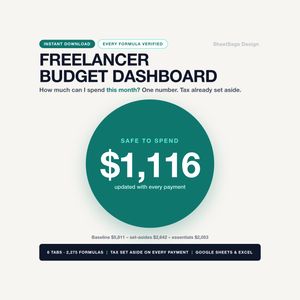 Some months you invoice $6,000. Some months, $900. This tells you what you can actually spend.…
See the Freelancer Variable-Income Budget & Tax Dashboard →