
The Rosh Hashanah Cooking Timeline: Feeding Two Days of Yom Tov and Shabbat Without the 4:30 PM Panic
This year the calendar is not doing hosts any favors. Rosh Hashanah 5787 comes in on Friday evening, September 11, 2026, and its first day is itself Shabbat — so Shabbat sits at the start of the run rather than after it, and roughly five or six festive meals arrive back to back with no supermarket run in the middle. Two weeks later Sukkot does exactly the same thing, on Friday September 25, and then keeps going for another nine days. This is the September that eats the whole month, and the planning problem is the same one three times over.
Most holiday planning advice focuses on the menu. But if you have hosted even once, you know the menu was never the hard part. The hard part is arithmetic — and it shows up in three specific places.
Problem 1: The recipe serves 8. Fourteen people are coming.
Every family recipe is written for some base number of servings, and no meal ever matches it. First-night dinner is fourteen people, second-night is twelve, lunch is ten. So you stand in the kitchen multiplying: 14 guests on a recipe that serves 8 is 1.75 batches, which means 1.75 times every single ingredient — and then the same again for the next meal at a different guest count.
Do that for ten dishes across five meals and you have done a few hundred multiplications by hand, usually at 11 PM, usually twice, because you didn't trust the first pass.
The fix: write each recipe down once, at its base servings, with its ingredients per batch. Then let a spreadsheet carry the guest count of each meal through the math. When your cousin calls to say her family is coming after all, you change one number and every quantity downstream moves with it.
Problem 2: The shopping list gets written twice — and still misses things
The classic system is a legal pad: go through each dish, write down what it needs, then try to merge the duplicates. Carrots appear in the tzimmes, the roasted vegetables, the soup and the salad — four separate lines that should be one line at the store.
A generated list solves both halves of this. Built from the menu, ingredient by ingredient, it adds up everything the holiday actually needs (18.5 lb of carrots across four recipes, to take a real example from our template's sample data), subtracts what is already in your pantry, and — the part that saves the most time — sorts itself by the departments of your own supermarket, in the order you walk it. Produce first, then deli, then meat, then the dry goods at the back.
Problem 3: Four dishes, four temperatures, one oven
Here is the failure mode that actually ruins the timing every year: it is 4:30 on Friday afternoon, candle lighting is at 6:45, and you suddenly realize the brisket wants 325°F, the kugel wants 375°F, and the roasted vegetables want 425°F — at the same time, in the same oven.
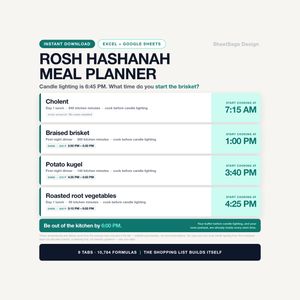
No printed planner can catch that, because a printed planner does not know what time each dish goes in. A spreadsheet that works backwards from candle lighting can: give each dish its prep time, cook time, oven temperature and a deadline ("must be done before candles" vs. "can be reheated"), and it can tell you when to start each dish — cholent at 7:15 AM, brisket at 1:00 PM — and flag the collision on Tuesday, while you can still fix the menu, instead of at 4:30 on Friday.
The three-day math
A Yom Tov whose first day is itself Shabbat adds one more layer: for part of the stretch you may not be cooking at all, depending on your practice. That turns each dish into a small logistics decision — make ahead and freeze, make ahead and refrigerate, cook before candle lighting, or serve cold. The dishes that must be cooked fresh compete for the same pre-candles window, which is exactly why the oven-clash problem gets worse on a three-day cycle.
(One important note: what may be cooked or warmed when is a halachic question, and a spreadsheet has no business answering it. Set those rules with your rabbi; the planner's job is only to hold you to the plan you chose.)
A checklist that survives contact with Thursday
Whatever tools you use, the structure that works looks like this:
- One recipe library. Every dish written once, with base servings, ingredients per batch, prep and cook times, and oven temperature.
- One meals table. Each meal with its date, its serving time and its guest count.
- A generated shopping list, merged across all recipes and meals, minus your pantry, sorted by aisle.
- A backwards timeline from candle lighting, with each dish's start time and oven window on one page.
- A make-ahead list in date order — what freezes, what keeps, what has to be same-day.
- A budget line. Cost per ingredient rolls up to cost per dish, per meal and per guest — so an over-budget holiday announces itself at the kitchen table, not at the register.
Build that once and it is not really a Rosh Hashanah tool anymore. It is the same system for every Shabbat, for Sukkot, for Pesach, for the bar mitzvah kiddush — the recipe library you typed is the slow part, and you only type it once.
Doing it without retyping the math every Yom Tov
None of the six items above is hard on its own. Scaling one recipe to one guest count is a single multiplication. What is hard is doing that multiplication for ten dishes across five meals, merging the results into one shopping list by hand, and then working out four oven windows against one candle-lighting time — every single Yom Tov, usually on the Thursday before.
Our Jewish Holiday & Shabbat Hosting Command Center is this system already built. Every recipe carries its own base servings, so typing a guest count once carries the batch math all the way through to the shopping list — fourteen guests on a recipe that serves eight becomes 1.75 batches, and every ingredient scales with it. The shopping list builds itself from the menu, ingredient by ingredient, subtracts what you already have, and re-sorts into the order you walk your own store. The cooking timeline works backward from your candle-lighting time and writes a start time for every dish — and it catches the oven clash: in the example file it flags four dishes needing 325°F, 375°F, 400°F and 425°F in the same window, in words, on the row, days before Friday afternoon. It also prices the whole holiday against your own budget before you shop.
Google Sheets and Microsoft Excel, one file, instant download, no subscription.
Two weeks later, Sukkot multiplies all three problems
Rosh Hashanah is two days. Sukkot is nine, and every one of them has a meal on it: two nights and two days of Yom Tov starting Friday September 25, then the whole of Chol HaMoed from September 28 to October 2, then Shemini Atzeret on October 3 and Simchat Torah on October 4. Fifteen meals in the example plan, with a different number of people at the table almost every night.
Everything above gets harder at that length, and one thing appears that has no equivalent at Rosh Hashanah: the food is cooked in a kitchen and eaten outside. The kugel that was perfect at 7:00 PM is lukewarm by the time it has crossed the yard. That is a scheduling problem, not a cooking problem — it means every course needs a leave the kitchen time as well as a start time, and it means some dishes simply should not be the ones going out hot.
Two other things change at nine days. The shopping stops being one trip: in our Sukkot example data, round challah appears on eleven of the fifteen meals at four different guest counts, which the list merges into 20.25 batches, 162 servings and 40.5 lb of bread flour on a single line. And the make-ahead cooking stops being an afternoon — it becomes 46 dishes across sixteen days, including the cooking you do between the days, on Chol HaMoed, for the nights that come after.
That is why we built the Sukkot version as its own file rather than telling people to reuse the Rosh Hashanah one. The Sukkot & Ushpizin Hosting Planner has an In The Sukkah column on every meal and a Holds Heat On The Way Out column on every recipe: you tell it how long the carry takes, and it works out what time each course has to leave the kitchen — 7:03 PM for a 7:15 PM meal — and flags any dish going out hot that you marked as one that does not survive the trip. Eighteen meal rows, enough for the first night through Simchat Torah, plus everything the Rosh Hashanah file does.
Turn the sukkah column off and it is a Shabbat planner for the other forty-three weeks of the year.
The other September deadline nobody schedules
There is one more thing that comes due before candle lighting on September 11, and it never makes it onto the cooking timeline because it is not cooking: the cards.
The card you actually want is never in the shop down the road, and the ones worth ordering online stop arriving in time well before the holiday. The version of that problem that has an answer is a printable set — sixteen Rosh Hashanah cards drawn as original vector artwork, in four styles (classic illustration, modern minimal, geometric, and a Hebrew lettering set with the transliteration and an English greeting underneath), as five print-ready PDFs for US Letter and A4.
Two of the files print two cards to a sheet with trim marks; the other two are quarter-fold, so there is nothing to cut at all — fold the page twice and the greeting is inside with clear space to sign. The cut cards and the Letter quarter-fold all finish at 4.25 x 5.5 in, the standard A2 card size; the A4 quarter-fold finishes at A6, 105 x 148 mm, which is what a C6 envelope is made for. A four-page guide covers paper weights, print settings and a two-minute scale test, so the first sheet you print is the right size.
At $6.99 it is the cheapest problem you will solve all month, and unlike the brisket it can be done at 11 PM.
This is a planning tool only, not halachic guidance — ask your rabbi. It does not rule on what may be cooked, warmed, carried or prepared, on eruv tavshilin, on kashrut, or on where and when you must eat, and it does not calculate candle-lighting times or any other zman; you type your own local time in. All quantities, prices, times and temperatures quoted above come from the example data included in the files and are editable placeholders, not recommendations, market prices, or a forecast of what your own holiday will cost.
 Every planner on this page gives you a blank page to write on. This one does the arithmetic.…
See the Jewish Holiday & Shabbat Hosting Command Center →